Khula Lawyers in Islamabad for Family Court Proceedings
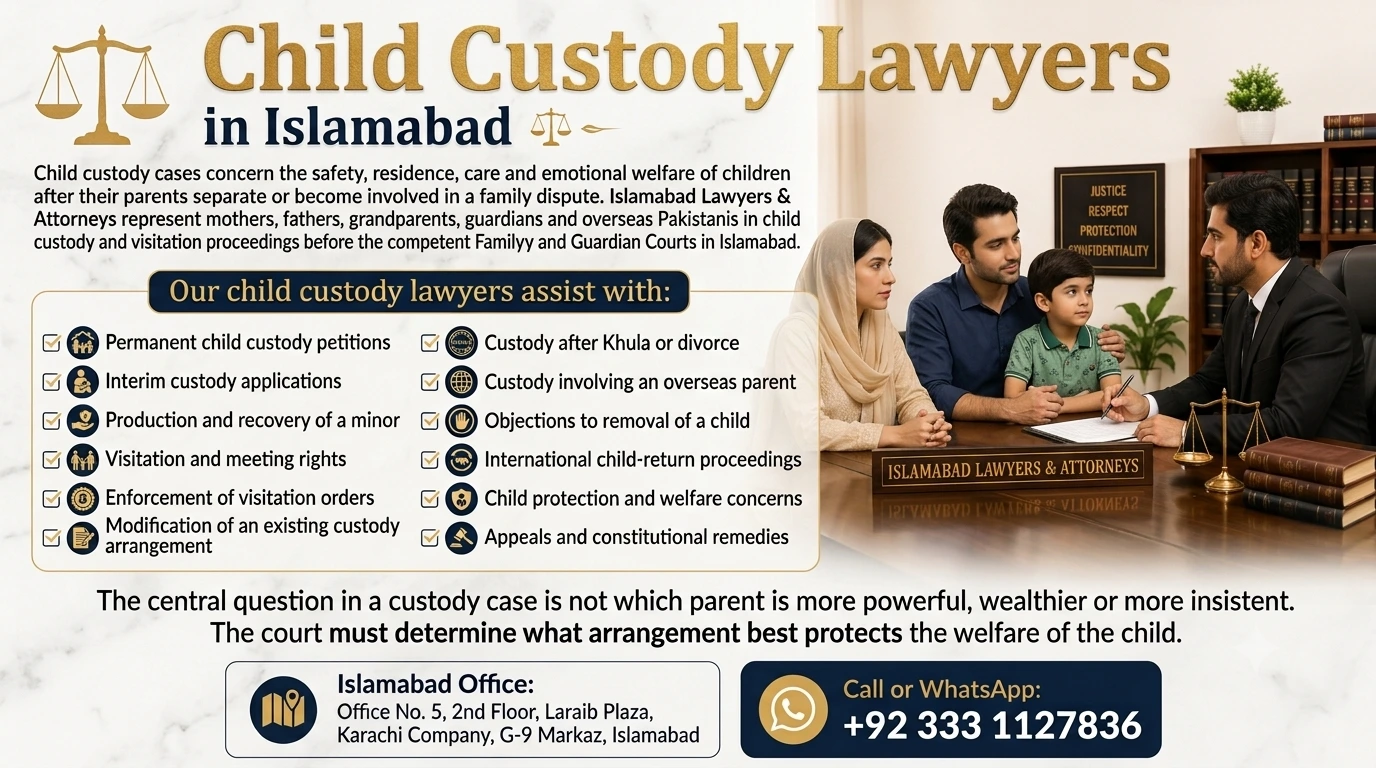
Child custody cases concern the safety, residence, care and emotional welfare of children after their parents separate or become involved in a family dispute.
Islamabad Lawyers & Attorneys represent mothers, fathers, grandparents, guardians and overseas Pakistanis in child custody and visitation proceedings before the competent Family and Guardian Courts in Islamabad.
Our child custody lawyers assist with:
- Permanent child custody petitions
- Interim custody applications
- Production and recovery of a minor
- Visitation and meeting rights
- Enforcement of visitation orders
- Modification of an existing custody arrangement
- Custody after Khula or divorce
- Custody involving an overseas parent
- Objections to removal of a child
- International child-return proceedings
- Child protection and welfare concerns
- Appeals and constitutional remedies where legally appropriate
The central question in a custody case is not which parent is more powerful, wealthier or more insistent. The court must determine what arrangement best protects the welfare of the child.
Islamabad Office: Office No. 5, 2nd Floor, Laraib Plaza, Karachi Company, G-9 Markaz, Islamabad
Consult a Child Custody Lawyer in Islamabad
Urgent legal advice may be required where:
- A child has been taken away without consent
- A parent is being completely denied access
- The child may be removed from Islamabad or Pakistan
- An existing custody order is being violated
- The child is being concealed
- There are allegations of abuse or neglect
- A passport or travel document is being sought
- Schooling or medical treatment is being disrupted
- One parent is threatening permanent relocation
- A parent living abroad needs access or representation
Delay can materially affect the existing caregiving arrangement. The lawyer should be informed immediately where there is a genuine risk that the child may be moved, concealed or exposed to harm.
Child Custody Law in Islamabad
Child custody and guardianship proceedings are principally governed by:
- The Guardians and Wards Act, 1890
- The Family Courts Act, 1964
- Applicable Muslim or other personal law
- The Islamabad Capital Territory child-protection framework
- Constitutional and superior-court principles concerning the welfare of children
The Family Courts Act gives Family Courts exclusive jurisdiction over custody of children, visitation rights and guardianship. It also provides that a Family Court is deemed to be a District Court for proceedings under the Guardians and Wards Act and must follow the procedure prescribed by that Act.
Custody, Guardianship and Visitation
These terms are connected, but they do not mean the same thing.
Legal issue | What it concerns |
Physical custody | Where the child lives and who provides day-to-day care |
Interim custody | A temporary arrangement while the main case is pending |
Guardianship of person | Legal authority and responsibility concerning the child |
Guardianship of property | Legal management of property belonging to the minor |
Visitation rights | Meetings and communication with the non-custodial parent |
Production of minor | Court direction requiring the child to be brought before it |
Return of child | Recovery or return where the child has been removed or retained |
Relocation | Moving the child to another city or country |
International return | Proceedings involving cross-border removal or retention |
A parent may have visitation rights without physical custody. Similarly, a person caring for the child may still require a formal guardianship order for a passport, immigration, education, property or another official purpose.
Detailed guardianship-certificate matters will be covered on the dedicated Guardianship Lawyers in Islamabad .
Table of Contents
Welfare of the Minor Is the Primary Consideration
The Guardians and Wards Act authorises the court to appoint or declare a guardian where doing so is necessary for the welfare of the minor.
When determining welfare, the court may consider:
- Age of the child
- Sex of the child
- Religion of the child
- Character of the proposed guardian
- Capacity to provide proper care
- Relationship with the child
- Wishes of a deceased parent
- Existing and previous relationship with the child
- Child’s own preference where the child is mature enough
- Health, education and emotional needs
- Stability and safety of the proposed home
The statute expressly permits the court to consider an intelligent preference expressed by a child who is old enough to form one.
Welfare Does Not Mean Financial Wealth Alone
A higher income does not automatically make one parent a better custodian.
Financial capacity is relevant because children need food, education, medical care and stable accommodation. However, the court may also consider:
- Who has historically provided daily care
- Emotional attachment
- Availability of the parent
- Safety of the household
- School continuity
- Health needs
- Conduct towards the child
- Support from responsible family members
- Willingness to maintain the child’s relationship with the other parent
- Risk of neglect, manipulation or violence
A parent should not assume that having a larger house, higher salary or foreign nationality will by itself determine custody.
Mother’s Custody Rights
A mother may seek custody where she has been the child’s primary caregiver or where residence with her serves the child’s welfare.
Relevant considerations may include:
- Age and dependency of the child
- Feeding and medical needs
- Existing attachment to the mother
- Continuity of daily care
- Schooling and routine
- Safety and stability
- Mother’s conduct and capacity
- Availability of suitable accommodation
- Child’s relationship with siblings
- Whether the mother facilitates access to the father
Traditional principles concerning maternal custody remain relevant but should not be treated as rigid rules that override the welfare of the child.
A mother does not automatically lose custody merely because:
- She has obtained Khula
- She is financially dependent
- She lives with her parents
- The father earns more
- The father is recognised as a natural guardian
- She needs maintenance for the child
Each case must be decided on its own facts.
Father’s Custody Rights
A father may apply for custody where residence with him is in the best interests of the child.
The court may consider:
- Father’s relationship with the child
- Previous involvement in upbringing
- Ability to provide direct care
- Proposed living arrangement
- School and healthcare arrangements
- Conduct towards the mother and child
- Existing contact with the child
- Work schedule and availability
- Support available within the household
- Child’s wishes
- Any risk in the present custodial environment
A father’s legal status and maintenance responsibility do not automatically entitle him to immediate physical custody. Equally, he should not be treated only as a source of financial support and denied a meaningful parental relationship without lawful reason.
Does the Mother Automatically Receive Young Children?
There are traditional rules concerning the mother’s right of Hizanat and the ages at which particular presumptions may operate.
However, custody should not be presented as an automatic age-based transfer from the mother to the father.
The court retains responsibility to determine:
- What arrangement serves the child’s welfare
- Whether the present caregiver is suitable
- Whether changing custody would harm the child
- Whether the child is settled in school and home
- Whether either parent has neglected or mistreated the child
- Whether the child has a mature and independent preference
The welfare assessment remains more important than a mechanical application of age alone.
Does the Mother Lose Custody After Remarriage?
Remarriage may be a relevant circumstance, but it should not be described as an automatic and irreversible disqualification.
The court may examine:
- Identity and conduct of the new spouse
- Safety of the child
- Relationship between the child and new household members
- Accommodation
- Existing stability
- Whether the child is being properly cared for
- Relationship with the biological father
- Comparative welfare arrangements proposed by both parents
The question remains whether custody with the mother continues to serve the welfare of the child.
Does the Father’s Second Marriage Affect Custody?
A father’s second marriage may also be considered where he seeks physical custody.
The court may examine:
- Proposed household arrangements
- Relationship of the child with the stepmother
- Availability of direct care
- Presence of other children
- Safety and privacy
- Schooling
- Emotional adjustment
- Whether the father himself will provide care
- Whether the proposed arrangement is practical
Neither parent’s remarriage should be considered in isolation from the child’s actual living conditions and welfare.
Interim Child Custody
Custody cases may take time, while the child requires an immediate and workable arrangement.
Section 12 of the Guardians and Wards Act allows the court to direct production of the minor and make temporary orders for custody and protection while the case remains pending.
An interim custody application may be appropriate where:
- The child has recently been removed
- A parent has been denied all access
- The existing environment may be unsafe
- School attendance is being affected
- Medical treatment is required
- The child has been concealed
- There is a risk of relocation
- An immediate holiday or visitation arrangement is required
- The present custodian is unable to care for the child
Interim custody does not necessarily determine the final case. The court may alter the temporary arrangement after considering evidence.
Production and Recovery of a Minor
The court may direct the person having custody of a child to produce the minor before it.
This power may be used to:
- Confirm the child’s location
- Assess immediate welfare
- Prevent concealment
- Facilitate an interim meeting
- Consider temporary custody
- Hear the child where appropriate
- Ensure compliance with an existing order
The Guardians and Wards Act also permits the court to order return of a ward where return to the guardian’s custody serves the child’s welfare. The Act makes welfare a condition of return rather than treating recovery as a purely proprietary right of an adult.
Child Custody Procedure in Islamabad
Step 1: Initial Case Assessment
The lawyer reviews:
- Existing custody arrangement
- Child’s ordinary residence
- History of caregiving
- Date and circumstances of separation
- Existing Family Court cases
- Safety concerns
- School and health records
- Present location of the child
- Proposed custody arrangement
- Desired visitation schedule
- Risk of removal or concealment
The legal strategy should be based on the child’s actual circumstances rather than only on accusations between parents.
Step 2: Determine Jurisdiction
For guardianship of the person of a minor, the application is generally filed before the court having jurisdiction where the minor ordinarily resides.
For guardianship of property, jurisdiction may also be connected with the place where the minor’s property is situated.
“Ordinary residence” is a factual and legal question. It is not always determined merely by:
- A temporary visit
- Recent forcible removal
- Address printed on a parent’s CNIC
- Place of birth
- Location of extended family
- A short stay made to create jurisdiction
The child’s settled home, schooling, duration of residence and actual circumstances may be relevant.
Step 3: Prepare the Custody or Guardianship Petition
The petition should contain accurate information about:
- Name and date of birth of the child
- Religion and ordinary residence
- Current custodian
- Parents and near relatives
- Previous custody or guardianship proceedings
- Proposed guardian where applicable
- Reasons for seeking custody
- Existing welfare concerns
- Education and health
- Requested interim relief
- Proposed visitation arrangement
- Property of the minor, where relevant
Where formal appointment or declaration of a guardian is sought, the Guardians and Wards Act requires specified particulars and a declaration of willingness from the proposed guardian attested by two witnesses.
Step 4: File an Interim Application Where Necessary
An urgent application may request:
- Production of the child
- Temporary custody
- Immediate visitation
- Restriction on removal
- Protection of passport or travel documents
- Continuation of school
- Medical examination or treatment
- Safe handover arrangements
The requested order must be practical and connected with the child’s welfare.
Step 5: Service Upon the Other Parent
The court issues notice to:
- Parents of the minor
- Current custodian
- Proposed guardian where applicable
- Other persons considered necessary
The Guardians and Wards Act expressly requires notice to parents residing in Pakistan and to the person having custody or possession of the minor.
Accurate addresses and contact details should be supplied at the beginning.
Step 6: Reply and Counter-Allegations
The respondent may:
- Contest jurisdiction
- Defend the existing custody arrangement
- Seek custody
- Request visitation
- Raise safety allegations
- Dispute removal or concealment
- Challenge the proposed household
- Produce school, medical or financial records
- Seek a child-welfare assessment
Custody pleadings should remain focused on facts affecting the child rather than irrelevant allegations concerning the former marital relationship.
Step 7: Child-Welfare Assessment
The court may examine the child directly or seek assistance through a welfare or child-protection assessment where appropriate.
A 2025 Islamabad High Court judgment stated that the report of a Child Protection Officer should be treated as an essential aid when determining the custody, care or marital status of a minor under the Islamabad child-protection framework.
Such a report may assist the court, but the final decision remains judicial.
Step 8: Evidence
Evidence may concern:
- Child’s residence
- Existing caregiving
- School performance
- Medical needs
- Emotional condition
- Income and expenses
- Conduct of the parents
- Domestic environment
- Communication between parent and child
- Denial of visitation
- Risk of removal
- Previous orders
- Proposed future arrangements
Witnesses should have direct knowledge rather than merely repeating family allegations.
Step 9: Interaction With the Child
Where the child is mature enough, the court may speak with the child to understand:
- Current comfort and routine
- Relationship with each parent
- School and home environment
- Any genuine fear
- Child’s preference
- Whether the child has been coached or pressured
The Guardians and Wards Act allows consideration of an intelligent preference but does not make the child solely responsible for deciding the case.
Step 10: Final Custody and Visitation Order
The final order may determine:
- Physical custody
- Guardian of the person
- Visitation schedule
- Holiday access
- School arrangements
- Video communication
- Handover location
- Travel restrictions
- Passport-related conditions
- Responsibility for transportation
- Other safeguards required for welfare
Custody orders should be sufficiently clear to reduce future conflict.
Visitation and Meeting Rights
The Family Courts Act expressly includes parental visitation rights within Family Court jurisdiction.
A visitation arrangement may include:
- Weekly meetings
- Fortnightly meetings
- Weekend access
- Daytime access
- Overnight stays
- School-holiday access
- Eid arrangements
- Birthday meetings
- Video calls
- Telephone calls
- Supervised meetings
- Meetings at a neutral venue
- Meetings at court premises
The schedule should reflect:
- Child’s age
- School timetable
- Travel distance
- Relationship with the parent
- Medical needs
- Safety concerns
- Previous compliance
- Emotional comfort
- Practical transport arrangements
Visitation should not be reduced to a symbolic meeting for a few minutes where a meaningful relationship can safely be maintained.
Supervised Visitation
Supervised visitation may be appropriate where:
- The child has had no recent contact
- There are substantiated safety concerns
- The child is very young
- The relationship needs gradual rebuilding
- There is a risk of removal
- The parent has previously failed to return the child
- Neutral support is temporarily required
Supervision should not be demanded merely to humiliate the other parent. The reason for supervision should be connected with the welfare or safety of the child.
Denial of Visitation
One parent should not unilaterally terminate court-ordered contact merely because:
- Maintenance has not been paid
- The parents are personally hostile
- A second marriage has occurred
- The child initially resists transition
- Relatives disapprove of the meetings
Maintenance and visitation are legally distinct matters.
Where an order is being violated, the affected parent may seek:
- Enforcement
- Compensatory meetings
- A clearer handover mechanism
- Change of venue
- Police or court support where lawful
- Modification of the order
- Appropriate consequences for persistent non-compliance
The remedy should be sought through the court rather than by forcibly removing the child.
Can a Child Refuse to Meet a Parent?
The child’s views may be relevant, particularly where the child is mature enough to express an independent preference.
However, the court may also examine:
- Whether the refusal is genuine
- Whether the child has been coached
- Whether a parent is creating fear
- Length of separation
- Previous relationship
- Any history of abuse
- Whether gradual contact is appropriate
- Whether counselling or a neutral setting may help
A young child’s temporary reluctance during a difficult handover should not automatically be treated as a final rejection of the parent.
Custody After Khula or Divorce
A decree of Khula or completion of Talaq does not automatically determine final custody.
Custody may:
- Continue informally with the existing caregiver
- Be included as a connected claim in a dissolution case
- Be filed as a separate custody petition
- Require an interim application
- Require a separate visitation order
- Require formal guardianship for official purposes
The Family Courts Act permits custody and visitation claims to be included in a dissolution plaint, but the court must still determine those claims according to the child’s welfare.
Detailed Khula representation is covered on the Khula Lawyers in Islamabad page.
Child Maintenance and Custody
Custody and child maintenance are separate legal responsibilities.
The parent having physical custody may seek maintenance for:
- Food
- Clothing
- Residence
- School fees
- Books and transport
- Medical treatment
- Extracurricular needs
- Other reasonable expenses
A father should not be denied access only because maintenance is disputed. Similarly, failure to provide maintenance should not be used to suggest that the custodial parent alone must finance every need of the child.
Detailed financial claims will be covered on the Maintenance Lawyers in Islamabad page.
Relocation to Another City
A custodial parent may have genuine reasons to relocate, including:
- Employment
- Remarriage
- Family support
- Housing
- Education
- Safety
- Medical needs
However, relocation may affect:
- Existing visitation
- School continuity
- Travel costs
- Frequency of contact
- Ability to enforce orders
- Child’s relationship with the other parent
A parent planning relocation should obtain legal advice before moving the child where a custody case or visitation order exists.
The court may require a revised arrangement, including longer holiday access, online communication or responsibility for travel.
Removal of a Child From Pakistan
International travel can become a serious issue where one parent fears that the child will not be returned.
Relevant evidence may include:
- Passport possession
- Visa applications
- Airline bookings
- Foreign employment
- Previous threats
- Overseas family connections
- Immigration status
- Existing custody order
- History of non-compliance
- School withdrawal
- Sale or closure of local residence
Possible legal steps depend on urgency and may include an application concerning:
- Passport or travel documents
- Production of the child
- Restriction on removal
- Notice to relevant authorities
- Temporary custody
- Security or undertaking
- Modification of visitation
No parent should rely solely on an informal oral promise where there is a genuine and documented risk of permanent removal.
International Child Abduction and Return Proceedings
The Schedule to the Family Courts Act includes matters relating to return of a child under the Hague Convention on the Civil Aspects of International Child Abduction, 1980.
A cross-border case may require consideration of:
- Child’s habitual or ordinary residence
- Existing foreign custody rights
- Circumstances of removal or retention
- Foreign court orders
- Time elapsed
- Risk to the child
- Applicable treaty procedure
- Pakistani custody jurisdiction
- Immigration and passport records
- Urgency of interim protection
International child-return proceedings are not the same as an ordinary domestic custody dispute and require immediate specialised review.
Overseas Pakistani Parents
An overseas parent may seek:
- Child custody
- Visitation during visits to Pakistan
- Video-call arrangements
- Extended holiday access
- Permission for travel
- Enforcement of an existing order
- Representation through Power of Attorney
- Response to a custody case filed in Pakistan
- Recognition or consideration of foreign documents
- Protection against permanent removal
A Special Power of Attorney may assist with procedural representation, but the court may still require the parent’s personal statement, evidence or video-link participation.
An overseas address, passport details and immigration position should be disclosed accurately.
Can Grandparents Seek Custody?
A grandparent or another relative may apply where:
- Both parents are absent
- A parent has died
- Parents are unable to care for the child
- The child is already living with the relative
- There is neglect or danger
- The relative seeks formal guardianship
- The relative requires authority for education, health or property
The Guardians and Wards Act permits an application by a person claiming to be guardian and also by a relative or friend of the minor.
Grandparents do not receive custody automatically. Their relationship, existing care and proposed arrangement are considered through the welfare test.
Custody Where a Parent Has Died
Following the death of a parent, disputes may arise between:
- Surviving parent
- Paternal grandparents
- Maternal grandparents
- Other relatives
- A person named in a will
- Existing caregiver
The court may examine:
- Fitness of the surviving parent
- Existing relationship
- Child’s settled residence
- Wishes of the deceased parent
- Emotional attachment
- Education and health
- Property or inheritance concerns
- Proposed caregiving arrangement
The Guardians and Wards Act specifically lists the wishes of a deceased parent as one factor within the broader welfare assessment.
Custody and the Child’s Property
Physical custody does not automatically permit unrestricted control over property owned by the minor.
A guardian of property has fiduciary duties and may require court permission before:
- Selling immovable property
- Gifting property
- Mortgaging property
- Creating a long lease
- Using proceeds
- Managing substantial inherited assets
The Guardians and Wards Act requires a guardian of the person to attend to the child’s support, health and education. In contrast, a guardian of property must manage the minor’s assets prudently and subject to statutory restrictions.
Property guardianship will be covered in greater detail on the dedicated guardianship page.
Evidence Useful in a Child Custody Case
Useful evidence may include:
- Child’s birth certificate or B-Form
- Nikah Nama
- Khula or divorce documents
- School admission and attendance records
- School reports
- Medical records
- Vaccination record
- Proof of residence
- Photographs of living arrangements
- Communication with the child
- Messages showing denial of visitation
- Travel documents
- Previous court orders
- Police or medical records concerning safety
- Proof of expenses
- Work schedule
- Witnesses with direct knowledge
- Evidence of previous caregiving
Evidence should be relevant to the child’s welfare. Secretly edited recordings, false school records and coached statements may damage the client’s credibility.
Common Mistakes in Custody Cases
Removing the Child Without Legal Advice
A sudden removal may lead to urgent recovery proceedings and create an adverse impression.
Using the Child as a Messenger
Children should not be required to carry threats, payment demands or litigation messages between parents.
Denying Contact to Punish the Other Parent
Visitation should not be stopped merely because the matrimonial dispute is bitter.
Coaching the Child
A coached statement may be identified during judicial interaction and can harm both the child and the parent’s case.
Ignoring Existing Orders
A party should seek modification rather than simply refusing compliance.
Filing in the Wrong Court
Jurisdiction usually depends upon the child’s ordinary residence, not merely the applicant’s preferred city.
Making Every Marital Allegation a Custody Issue
Only conduct relevant to parenting, safety and welfare should dominate the custody pleadings.
Seeking an Impractical Schedule
A visitation plan must account for school, travel, the child’s age and the parent’s actual availability.
Parenting Plans and Custody Settlements
Parents may resolve custody and visitation through a written parenting arrangement where settlement is lawful and safe.
A parenting plan may cover:
- Primary residence
- Schooling
- Healthcare
- Religious upbringing
- Regular visitation
- Eid and holidays
- Birthdays
- Travel consent
- Passport custody
- Video communication
- Transportation
- Emergency decisions
- Education expenses
- Medical expenses
- Relocation
- Communication between parents
- Procedure for future disagreements
The agreement should be presented before the competent court where proceedings are pending.
A settlement between parents remains subject to the welfare of the child.
Modification of a Custody or Visitation Order
A custody arrangement may require modification where circumstances materially change.
Examples include:
- Change of school
- Relocation
- Parent moving abroad
- Serious health issue
- Persistent denial of access
- Unsafe household conditions
- Child reaching greater maturity
- Change in work schedule
- Repeated failure to return the child
- New evidence of neglect
- Existing schedule becoming impractical
The applicant should explain what has changed and why the proposed new arrangement better serves the child.
How Long Does a Child Custody Case Take?
No responsible lawyer should guarantee a fixed completion date.
The time may depend on:
- Service of notice
- Interim applications
- Court workload
- Child-welfare assessment
- Evidence
- Overseas parties
- Jurisdictional objections
- Repeated non-compliance
- Appeals or transfer proceedings
- Settlement negotiations
An urgent interim custody or visitation application may be decided before the final petition, but the timing remains subject to the court.
Documents Required for Initial Consultation
Bring clear copies of:
- Applicant’s CNIC or passport
- Child’s B-Form or birth certificate
- Nikah Nama
- Khula or divorce decree
- Talaq or Union Council documents
- Existing custody or visitation order
- Child’s school record
- Medical records
- Proof of current residence
- Other parent’s address
- Travel and passport documents
- Relevant messages
- Evidence of previous caregiving
- Proof of expenses
- Police or protection records where relevant
- Power of Attorney in an overseas case
Also prepare a chronological history focused on the child rather than only on the marital dispute.
Why Choose Our Child Custody Lawyers in Islamabad?
Islamabad Lawyers & Attorneys provides child-focused legal representation based on preparation, evidence and realistic advice.
Clients receive:
- Confidential consultation
- Assessment of jurisdiction
- Custody and visitation strategy
- Drafting of petitions and replies
- Interim custody applications
- Production and recovery applications
- Representation before Family and Guardian Courts
- Overseas-parent coordination
- Review of travel and relocation risks
- Assistance with enforcement
- Settlement and parenting-plan drafting
- Regular case updates
- Clear advice without guaranteed outcomes
We aim to protect the child’s welfare while pursuing the client’s lawful parental and guardianship rights.
About Our Senior Family Lawyer
Mohsin Ali Shah, M.A., LL.B., Senior Family Lawyer and Chairman of Qanoon Group Pakistan, supervises the child-custody practice.
He commenced legal practice in 1985 and has more than four decades of professional experience in family law, divorce, Khula, child custody, guardianship, maintenance, property law and related litigation.
The Islamabad team coordinates client consultation, pleadings, court appearances and overseas documentation from the G-9 Markaz office.
Speak to a Child Custody Lawyer in Islamabad
Before contacting the office, prepare a summary covering:
- Child’s name and age
- Present location of the child
- Current caregiver
- Date of separation
- Existing court orders
- Access currently available
- School and medical position
- Any immediate safety concern
- Risk of relocation or foreign travel
- Proposed custody or visitation arrangement
- Whether either parent lives abroad
- Next court date, if a case is pending
Islamabad Office: Office No. 5, 2nd Floor, Laraib Plaza, Karachi Company, G-9 Markaz, Islamabad
Frequently Asked Questions
The court decides custody according to the welfare of the child.
It may consider the child’s age, health, education, emotional attachment, present caregiver, safety, home environment and the ability of each parent to provide stable care.
The court may also consider the preference of a sufficiently mature child. Neither parent wins custody solely because of gender, income or legal status.
A mother may have a strong claim, particularly where she has provided daily care, and the child is young or dependent.
However, custody is not automatic in every case. The court assesses the mother’s caregiving, safety, stability, relationship with the child, and overall welfare circumstances.
Traditional maternal-custody principles remain subject to the welfare of the minor.
Yes. A father may obtain custody where the evidence shows that residence with him better serves the child’s welfare.
The court may examine his previous involvement, living arrangements, time available for direct care, schooling plan, household environment and relationship with the child.
His financial position alone does not automatically determine custody.
Remarriage may be considered but does not necessarily result in automatic loss of custody.
The court may examine the new household, safety, stability, relationship with the step-parent, existing caregiving and the comparative arrangements offered by both parents.
The deciding consideration remains the child’s welfare.
Yes. The Family Courts Act allows custody and parental visitation claims to be included in a dissolution plaint.
A separate custody petition may still be appropriate depending on urgency, the relief required and the procedural stage of the Khula case.
Custody is not automatically decided merely because Khula has been granted.
Interim custody is a temporary arrangement made while the main custody or guardianship case is pending.
The court may order production of the child, temporary residence with one party or an interim visitation schedule.
The interim order does not necessarily determine the final decision and may be changed after fuller evidence.
The court may direct the person having custody to produce the child and may make temporary or final orders concerning return and custody.
The applicant must provide the child’s location, present custodian and circumstances of removal.
The court will assess whether the requested return serves the child’s welfare.
A guardianship application concerning the person of a minor is generally filed where the child ordinarily resides.
Ordinary residence is not always the same as a temporary location or the address preferred by a parent.
Schooling, settled home, duration of residence and the actual circumstances may be relevant.
A relative or friend of the minor may apply under the Guardians and Wards Act.
Grandparents may have a strong factual case where they have cared for the child or where the parents are absent, deceased or unable to provide proper care.
They do not receive custody automatically; welfare remains decisive.
A sufficiently mature child may express a preference, and the court may consider it.
The child’s preference is not always final. The court may assess age, maturity, reasons for the preference and whether the child has been pressured or coached.
The responsibility for the legal decision remains with the court.
Visitation may be restricted, supervised or temporarily withheld where there is a genuine welfare or safety concern.
Mere hostility between parents is generally not enough to justify complete denial.
The court may design a supervised or gradual schedule where direct unsupervised access is not immediately appropriate.
Maintenance and visitation are separate legal issues.
A custodial parent should seek enforcement of maintenance through the appropriate legal process rather than unilaterally ending the child’s contact with the other parent.
Likewise, a parent should not stop supporting the child because access is being obstructed.
Yes. A parent may seek modification where the existing order has become impractical or no longer serves the child’s welfare.
Reasons may include school timing, relocation, travel distance, age, health, repeated non-compliance or a change in the parent’s availability.
The proposed schedule should be specific and workable.
The answer depends on custody status, existing court orders, guardianship, passport arrangements and the circumstances of the proposed travel.
Where a case is pending, or there is a genuine risk of permanent removal, the concerned parent should seek urgent legal advice.
An informal verbal assurance may not provide sufficient protection.
An urgent application may seek production, interim custody, travel-related restrictions, preservation of passport documents or another protective order.
The evidence should identify the risk, such as visa processing, tickets, foreign employment, previous threats or school withdrawal.
Relief depends on the facts and jurisdiction.
Yes. An overseas parent may seek a structured arrangement including visits during stays in Pakistan, extended holiday access and regular video communication.
The court may consider travel distance, previous contact, accommodation, return arrangements and the child’s age.
Representation through Power of Attorney may be possible, subject to the court’s requirements.
No. Physical custody concerns daily care and residence.
Guardianship may involve legal authority over the child’s person or property and may be needed for passports, immigration, school decisions, medical matters or inherited assets.
A person may require a formal guardianship order even where the child is already living with them.
Yes. A party may apply for enforcement where the other parent refuses to hand over the child, blocks court-ordered meetings or repeatedly violates the schedule.
The appropriate remedy depends on the wording of the order and nature of non-compliance.
A party should not use private force to enforce an order.
Useful evidence includes school and medical records, proof of residence, communication concerning access, existing orders, travel records and evidence of actual caregiving.
The strongest evidence usually concerns the child’s real daily life.
Irrelevant accusations about the failed marriage may distract from the welfare issues the court must decide.
Send the child’s B-Form, parents’ CNICs, Nikah Nama, divorce or Khula documents, existing court orders and current addresses.
Also provide school and medical records, relevant messages, travel information and a short timeline explaining where the child has lived, who has provided care and what immediate relief is required.
Can Grandparents Seek Custody?
A grandparent or another relative may apply where:
- Both parents are absent
- A parent has died
- Parents are unable to care for the child
- The child is already living with the relative
- There is neglect or danger
- The relative seeks formal guardianship
- The relative requires authority for education, health or property
The Guardians and Wards Act permits an application by a person claiming to be guardian and also by a relative or friend of the minor.
Grandparents do not receive custody automatically. Their relationship, existing care and proposed arrangement are considered through the welfare test.
Custody Where a Parent Has Died
Following the death of a parent, disputes may arise between:
- Surviving parent
- Paternal grandparents
- Maternal grandparents
- Other relatives
- A person named in a will
- Existing caregiver
The court may examine:
- Fitness of the surviving parent
- Existing relationship
- Child’s settled residence
- Wishes of the deceased parent
- Emotional attachment
- Education and health
- Property or inheritance concerns
- Proposed caregiving arrangement
The Guardians and Wards Act specifically lists the wishes of a deceased parent as one factor within the broader welfare assessment.