
Jactitation of Marriage Lawyers in Islamabad
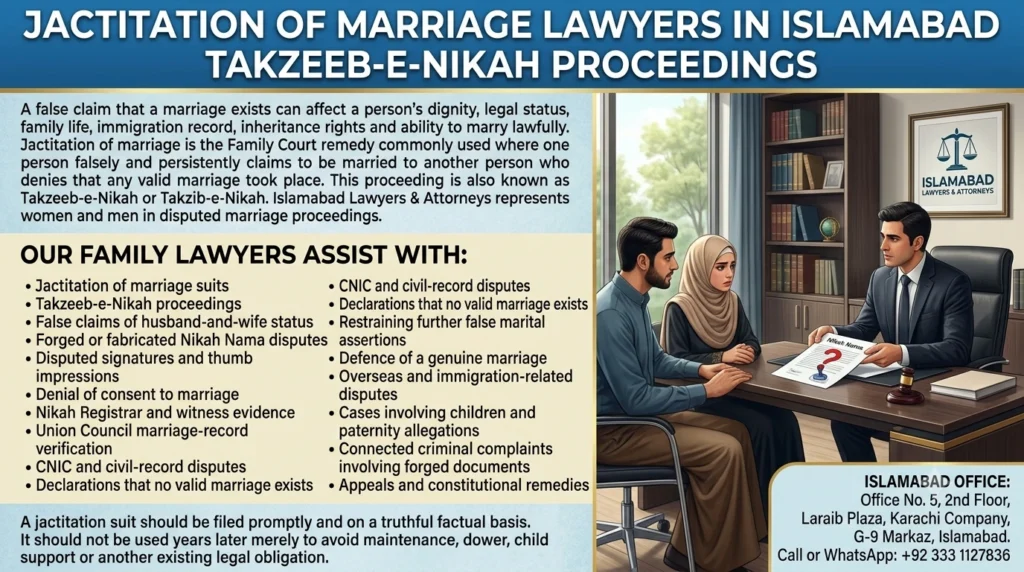
A false claim that a marriage exists can affect a person’s dignity, legal status, family life, immigration record, inheritance rights and ability to marry lawfully.
Jactitation of marriage is the Family Court remedy commonly used where one person falsely and persistently claims to be married to another person who denies that any valid marriage took place.
The proceeding is also commonly described as Takzeeb-e-Nikah or Takzib-e-Nikah.
Islamabad Lawyers & Attorneys represents women and men in disputed marriage proceedings before the competent Family Courts in Islamabad.
Our family lawyers assist with:
- Jactitation of marriage suits
- Takzeeb-e-Nikah proceedings
- False claims of husband-and-wife status
- Forged or fabricated Nikah Nama disputes
- Disputed signatures and thumb impressions
- Denial of consent to marriage
- Nikah Registrar and witness evidence
- Union Council marriage-record verification
- CNIC and civil-record disputes
- Declarations that no valid marriage exists
- Restraining further false marital assertions
- Defence of a genuine marriage
- Overseas and immigration-related disputes
- Cases involving children and paternity allegations
- Connected criminal complaints involving forged documents
- Appeals and constitutional remedies where available
A jactitation suit should be filed promptly and on a truthful factual basis. It should not be used years later merely to avoid maintenance, dower, child support or another existing legal obligation.
Islamabad Office: Office No. 5, 2nd Floor, Laraib Plaza, Karachi Company, G-9 Markaz, Islamabad
Consult a Jactitation of Marriage Lawyer
Obtain legal advice immediately where:
- Someone is publicly claiming to be your spouse
- A Nikah Nama has appeared without your knowledge
- Your signatures or thumb impressions are disputed
- A person has entered your name as spouse in official records
- Marriage-registration documents are allegedly fabricated
- You deny ever appearing before a Nikah Registrar
- You deny appointing a Vakil for the Nikah
- Consent to the alleged marriage is disputed
- A false marriage claim is being used for immigration
- Maintenance, dower or inheritance is being claimed
- A child’s legal status is connected with the dispute
- Criminal proceedings concerning abduction or forgery are pending
- The other party is threatening to circulate a Nikah Nama
- A foreign authority is relying on disputed marriage documents
- A previous court case concerning the same marriage already exists
The entire litigation history should be disclosed. Concealing an earlier Khula, maintenance, custody or marriage proceeding can seriously damage the case.
What Is Jactitation of Marriage?
Jactitation of marriage concerns a false assertion or pretence that two people are married when the complaining party says no valid marriage exists.
The remedy may seek:
- A declaration that no valid marriage took place
- A declaration that no marital relationship exists
- Rejection of a false marital claim
- Restraint against repeating the false assertion
- Appropriate directions concerning disputed documents
- Consequential relief within the Family Court’s jurisdiction
The High Court of Sindh has explained the traditional meaning as a false boast or persistent allegation that one person is married to another, for which the affected person may seek a decree restraining further assertion.
Jactitation of Marriage Is a Family Court Matter
The Family Courts Act gives Family Courts exclusive jurisdiction over matters listed in its Schedule, which expressly includes jactitation of marriage.
The Family Court may therefore determine whether:
- A marriage was ever solemnised
- The alleged Nikah Nama is genuine
- The parties gave valid consent
- A Vakil was lawfully appointed
- Ijab-o-Qabool occurred
- The alleged witnesses were present
- The Nikah was registered
- The person asserting marriage has proved the claim
- The person denying marriage has established the pleaded fraud or fabrication
The exact issues depend on the pleadings and documents produced by both sides.
Table of Contents
Jactitation, Khula, Dissolution and Annulment
These remedies should not be used interchangeably.
Proceeding | Main legal position |
Jactitation of marriage | Plaintiff says no valid marriage exists |
Khula | Wife accepts the marriage but seeks judicial dissolution |
Dissolution on legal grounds | Wife accepts the marriage and seeks termination on a recognised ground |
Talaq | Husband terminates an existing marriage through the statutory process |
Restitution of conjugal rights | Spouse asserts that a valid subsisting marriage exists and seeks reunion |
Correction of marriage record | Marriage is accepted, but an entry is incorrect |
Criminal forgery proceedings | Concern criminal liability for allegedly fabricated documents |
A person should not file Khula if their case is that they were never married at all.
Similarly, a person who previously admitted the marriage, contested a Khula case or accepted matrimonial benefits may face serious evidentiary difficulties if they later deny the entire marriage.
Takzeeb-e-Nikah Meaning
Takzeeb-e-Nikah generally refers to denial or repudiation of an alleged marriage.
A typical claim may state that:
- No Nikah ceremony occurred
- No consent was given
- No authorised Vakil was appointed
- The Nikah Nama is forged
- Signatures or thumb impressions are not genuine
- The alleged witnesses were not present
- The Nikah Registrar made or relied upon a false entry
- The defendant is falsely presenting themselves as spouse
- The false assertion is causing legal and reputational harm
The court does not decide the case from the label alone. It examines the precise allegations and available evidence.
When Can a Jactitation Suit Be Filed?
A suit may be appropriate where a person falsely asserts marriage by:
- Producing an allegedly forged Nikah Nama
- Entering a false spouse status in official records
- Claiming maintenance or dower based on a denied marriage
- Representing themselves publicly as husband or wife
- Using disputed marriage documents in immigration proceedings
- Filing restitution of conjugal rights based on an alleged false Nikah
- Claiming inheritance as spouse
- Presenting false marriage information to a school, hospital or employer
- Circulating marriage documents online
- Attempting to prevent the other person’s lawful marriage
- Claiming parentage or family status through disputed documents
A single private misunderstanding may not require full litigation. The assertion should be legally material or sufficiently persistent to require judicial determination.
Filing at the Earliest Opportunity
A person who learns of an allegedly false marriage should act promptly.
A 2025 High Court judgment treated substantial delay, earlier knowledge, prior litigation and failure to challenge the alleged marriage at the first opportunity as highly relevant. The court also warned against using a belated jactitation claim to avoid obligations relating to a woman or child.
Delay may raise questions such as:
- Why was no immediate denial made?
- Why were official records not challenged earlier?
- Why was a previous family case contested without denying marriage?
- Why was a Khula decree left unchallenged?
- Why were maintenance or child proceedings allowed to continue?
- Did the plaintiff previously acknowledge the relationship?
- Is the present suit an afterthought?
A delayed case is not necessarily impossible, but the delay must be explained honestly and with supporting evidence.
Who Can File the Suit?
The suit is ordinarily filed by the person who says they are being falsely represented as the spouse of the defendant.
The plaintiff may be:
- A woman falsely described as a wife
- A man falsely described as a husband
- A person whose official record has been altered
- A person facing a false maintenance or inheritance claim
- A person against whom a disputed Nikah Nama is being used
The person alleging reputational or legal injury should generally be the claimant.
Relatives should not ordinarily file in place of a competent adult merely because they oppose the alleged marriage.
Defence of a Genuine Marriage
A person defending the marriage may rely on:
- Original Nikah Nama
- Certified marriage record
- Nikah Registrar’s register
- Marriage Registration Certificate
- Evidence of Ijab-o-Qabool
- Nikah witnesses
- Vakil and witnesses to appointment
- Photographs and videos
- Messages between the parties
- Admissions
- Cohabitation
- Joint travel
- Shared residence
- Birth records of children
- CNIC marital status
- Previous court pleadings
- Maintenance or Khula proceedings
- Dower payment
- Conduct recognising the marriage
A registered Nikah Nama is significant evidence, but the complete evidentiary record remains important where signatures, consent or the underlying ceremony are specifically challenged.
Forged or Fabricated Nikah Nama
A forged Nikah Nama allegation may involve:
- False signatures
- False thumb impressions
- Substituted pages
- Altered date
- Incorrect bride or groom particulars
- Fabricated witnesses
- False Nikah Registrar stamp
- Unauthorised entries
- False Union Council registration
- Use of another person’s CNIC
- Post-event preparation of a document
- Fraudulent appointment of a Vakil
The plaintiff should identify exactly which portion is alleged to be forged.
A general statement that “the whole Nikah Nama is fake” may be insufficient without explaining:
- How the document came into existence
- Which signatures are denied
- Whether the plaintiff was present
- Whether the witnesses are known
- Whether any ceremony occurred
- When the plaintiff first obtained knowledge
- What action was taken after discovery
Disputed Signatures and Thumb Impressions
Where execution is denied, relevant steps may include:
- Production of the original Nikah Nama
- Comparison with admitted signatures
- Comparison with admitted thumb impressions
- Examination of the Nikah Registrar
- Examination of attesting witnesses
- Examination of the alleged Vakil
- Forensic or handwriting examination where ordered
- Inspection of the official registration record
- Review of ink, alterations or overwriting
- Examination of CNIC copies attached to the record
Photocopies should not be treated as equivalent to originals where forensic examination is required.
The party holding the original document should preserve it and should not write on, laminate or alter it.
Disputed Consent to Marriage
A valid marriage dispute may involve whether the bride or groom freely consented.
The court may examine:
- Presence at the ceremony
- Words of offer and acceptance
- Identity of the parties
- Appointment of a Vakil
- Conduct before and after the alleged marriage
- Threats or coercion
- Age and legal capacity
- Witness testimony
- Messages and recordings
- Whether the party immediately repudiated the alleged marriage
- Whether the party later lived as spouse
- Whether benefits under the Nikah Nama were claimed
A consent dispute is not decided solely because a document bears a signature. Conversely, a later denial does not automatically invalidate a ceremony proved through credible evidence.
Nikah Through a Vakil
Where one party was absent, and the Nikah was allegedly performed through a Vakil, the court may examine:
- Whether authority was actually given
- Whether the authority was oral or written
- Identity of the Vakil
- Witnesses to appointment
- Scope of authority
- Bride or groom’s free consent
- Terms communicated to the absent party
- Dower agreed
- Identity verification
- Subsequent confirmation or denial
- Record made in the official Nikah Nama
A person who never appointed the alleged Vakil may dispute the foundation of the claimed marriage.
The defendant must not rely merely on the existence of a Vakil entry without proving lawful authority where it is specifically denied.
Nikah Registrar’s Evidence
The Nikah Registrar may be an important witness concerning:
- Whether the ceremony occurred
- Identity of bride and groom
- Verification documents
- Presence of witnesses
- Vakil particulars
- Signatures or thumb impressions
- Date and location
- Dower entries
- Registration number
- Submission to the Union Council
- Alterations in the form
- Custody of the original record
The lawyer should obtain the official record rather than relying only on a privately held photocopy.
Nikah Witnesses
The alleged witnesses may be questioned about:
- Date and place of Nikah
- Identity of the parties
- Who was physically present
- Words of Ijab-o-Qabool
- Appointment of Vakil
- Amount of Haq Mehr
- Identity-document verification
- Signing of the Nikah Nama
- Relationship with the parties
- Events before and after the ceremony
A witness who merely signed later without attending the Nikah may face serious credibility issues.
Union Council Marriage Record
The official marriage record may contain:
- Nikah Nama registration number
- Date of registration
- Nikah Registrar details
- Bride and groom particulars
- CNIC information
- Entries concerning Vakil and witnesses
- Dower
- Certified copy
- Marriage Registration Certificate
- Dispatch or receipt record
The record should be compared with:
- Original Nikah Nama
- Copies held by the parties
- CNIC data
- Nikah Registrar’s register
- Dates of alleged solemnisation and registration
An inconsistency does not automatically prove forgery, but it may require explanation and evidence.
Unregistered Nikah and Jactitation
Absence of registration should not automatically be equated with absence of marriage.
The High Court has noted that non-registration under the Muslim Family Laws Ordinance does not by itself necessarily make an otherwise proved Muslim marriage invalid.
The court may therefore examine whether:
- Ijab-o-Qabool occurred
- Free consent existed
- Required witnesses were present
- The parties held themselves out as married
- Cohabitation occurred
- Dower was fixed or paid
- Children were born
- The marriage was later acknowledged
A jactitation case cannot succeed solely because the Nikah was not entered in the Union Council register.
Marriage Registration Certificate and NADRA Records
A Marriage Registration Certificate or marital-status entry may support the person asserting marriage, but the underlying source should be examined where fraud is alleged.
The court may review:
- Documents supplied for the entry
- Union Council record
- CNIC applications
- Spouse CNIC
- Nikah Registrar’s certificate
- Birth records of children
- Previous applications
- Objections filed with the authority
- Timing of the change
- Whether the affected party received notice
An administrative authority should not finally determine a seriously disputed marital status without considering the legally affected parties and relevant judicial proceedings.
Is NADRA the Correct Forum to Decide a Marriage Dispute?
NADRA maintains identity records but does not replace the Family Court’s jurisdiction to adjudicate a contested marriage.
Where marital status is disputed, the party may need:
- A Family Court declaration
- Certified judgment and decree
- Correction through the relevant Union Council
- Consequential correction of identity records
- Supporting affidavits and documents
A request to change CNIC marital status should be based on a lawful record rather than a private allegation alone.
Burden of Proof
The plaintiff should prove the pleaded case that the marital assertion is false and that no valid marriage exists.
Where the defendant relies on a Nikah Nama, witnesses and official records, the authenticity and legal effect of those materials may become central issues.
The High Court has emphasised that the person challenging an established marital and child-status record carries a serious evidentiary burden and should raise the challenge at the earliest opportunity.
The burden can shift on particular facts and documents, but neither party should assume that a bare denial or bare photocopy will decide the case.
Evidence for the Plaintiff Denying Marriage
Useful evidence may include:
- CNIC and passport records
- Travel history
- Employment attendance
- Location evidence
- Communications immediately denying marriage
- Complaints to Nikah Registrar or Union Council
- Notices sent after discovering the document
- Admitted signatures and thumb impressions
- Evidence that no Vakil was appointed
- Evidence that alleged witnesses were absent
- Foreign-residence documents
- Previous marital-status records
- Evidence of another subsisting marriage
- Forensic comparison
- Evidence of threats or fabrication
- Earlier court pleadings consistently denying marriage
The evidence should address the precise alleged date and manner of Nikah.
Evidence for the Defendant Asserting Marriage
Useful evidence may include:
- Original registered Nikah Nama
- Certified Union Council record
- Nikah Registrar testimony
- Nikah witnesses
- Vakil appointment evidence
- Photographs or video
- Communications acknowledging marriage
- Cohabitation evidence
- Joint address
- Dower payment
- Gifts or wedding arrangements
- Birth record of children
- CNIC spouse entry
- Previous maintenance, Khula or custody pleadings
- Admissions made before relatives or authorities
- Foreign visa or immigration application naming the spouse
The defendant should preserve original evidence and avoid relying on edited screenshots or recreated documents.
Children and Jactitation of Marriage
A jactitation case may have profound consequences where a child is connected with the disputed relationship.
The court may consider:
- Birth certificate
- B-Form or CRC
- Recorded father’s name
- Prior acknowledgement of paternity
- Maintenance payments
- School records
- Previous court pleadings
- Conduct of the alleged father
- Timing of the denial
- Presumptions protecting legitimacy
Superior courts have repeatedly cautioned against casually stigmatising a child as illegitimate. In the 2025 High Court case, the delay, prior conduct and potential harm to the child were treated as major considerations.
A marriage-denial suit should not be filed simply to avoid child maintenance.
Jactitation and Paternity Are Not Always the Same Issue
A declaration about marriage may affect but does not necessarily resolve every question concerning:
- Biological paternity
- Legal paternity
- Legitimacy
- Child maintenance
- Inheritance
- Birth records
- Guardianship
Separate pleadings or proceedings may be required depending on the relief sought.
No DNA testing request should be made casually where legal presumptions, dignity and the child’s welfare are involved.
Jactitation and Restitution of Conjugal Rights
Connected suits may arise where:
- One party files restitution alleging a valid marriage
- The other party files jactitation denying the marriage
The court must first determine whether a valid matrimonial relationship exists before granting restitution.
A person cannot obtain restitution merely by asserting marriage where the underlying Nikah is genuinely disputed.
Detailed assistance is available on our Restitution of Conjugal Rights Lawyers in Islamabad page.
Jactitation and Maintenance Claims
A maintenance claimant must establish the relationship upon which the claim is based.
Where marriage is genuinely disputed, the court may need to determine:
- Whether the marriage existed
- Whether the Nikah Nama is genuine
- Whether the plaintiff previously acknowledged marriage
- Whether the maintenance defendant previously admitted marriage
- Whether a child’s maintenance claim remains independently maintainable
- Whether the jactitation suit is a tactic to avoid financial obligations
Filing jactitation does not automatically suspend every maintenance proceeding.
The cases should be coordinated to avoid inconsistent judgments.
Jactitation and Khula Proceedings
A person seeking Khula ordinarily accepts that a marriage exists and asks the court to dissolve it.
A later jactitation claim may be difficult where the same person:
- Filed or defended Khula proceedings
- Admitted the Nikah
- Allowed a Khula decree to become final
- Claimed Haq Mehr
- Contested maintenance as spouse
The High Court has treated an unchallenged Khula decree and earlier participation in matrimonial proceedings as relevant against a belated denial of marriage.
A party must explain any apparent contradiction between earlier and later pleadings.
Difference Between Fake Marriage and Invalid Marriage
These situations are not identical.
Alleged Fake Marriage
The plaintiff says:
- No Nikah occurred
- Documents were fabricated
- No consent was given
- No Vakil was appointed
- Witnesses are false
Alleged Invalid Marriage
The plaintiff may accept that a ceremony occurred but contend that:
- A legal requirement was missing
- Consent was obtained unlawfully
- A party lacked capacity
- A prohibited relationship existed
- The ceremony had another legal defect
The correct relief depends on whether the plaintiff denies the event itself or challenges its legal validity.
Forced Marriage Allegations
Where a person alleges coercion, the lawyer should assess:
- Age at the time
- Ability to consent
- Threats or confinement
- Who arranged the ceremony
- Whether signatures were voluntary
- Whether a Vakil was appointed freely
- Immediate conduct after the alleged Nikah
- Police, medical or protection records
- Statements before a magistrate
- Subsequent cohabitation or repudiation
- Child-marriage legislation where relevant
A Nikah Nama should not be treated as a substitute for proving voluntary consent where consent is specifically and credibly disputed.
Child Marriage and Disputed Nikah
Where either party was under the legally applicable marriage age, the case may involve:
- Islamabad child-marriage legislation
- Criminal consequences
- Validity or legal effect of the alleged marriage
- Capacity and consent
- Guardianship and protection
- Birth and identity records
- Other connected proceedings
These cases require immediate, fact-specific advice. The lawyer must verify the date of birth, date of alleged marriage and legislation applicable at that time.
Overseas and Immigration Cases
Jactitation disputes may arise where a person uses a disputed marriage for:
- Spouse visa
- Family reunification
- Immigration sponsorship
- Permanent residence
- Citizenship
- Foreign tax status
- Insurance
- Pension
- Inheritance
- Embassy registration
The evidence may include:
- Visa application
- Immigration forms
- Foreign marriage declaration
- Sponsor correspondence
- Passport records
- Embassy documents
- Attested Nikah Nama
- Foreign residence history
- Previous admissions
- Foreign court proceedings
A Pakistani Family Court declaration may be relevant abroad, but acceptance depends on the foreign authority’s law and authentication requirements.
Overseas Plaintiff or Defendant
An overseas party may participate through:
- Pakistani lawyer
- Properly attested Special Power of Attorney
- Certified foreign documents
- Embassy or consular attestation
- Video-link evidence where permitted
- Personal appearance where required
- International service of summons
A Power of Attorney does not automatically permit an attorney to give all personal evidence concerning consent, presence or signatures.
The court may require the actual party to testify.
Criminal Complaints and Forged Nikah Documents
An alleged false Nikah Nama may also lead to allegations involving:
- Forgery
- Use of forged document
- False information
- Identity misuse
- Fraud
- Abduction
- Coercion
- False registration
Criminal and Family Court proceedings serve different purposes.
The Family Court determines matrimonial status, while a criminal court considers alleged offences and criminal liability.
A recent High Court decision cautioned that criminal machinery should not be used merely as pressure in a dispute already involving jactitation of marriage.
Should Criminal Proceedings Be Filed First?
The sequence depends on the facts.
Immediate criminal or protective action may be necessary where there is:
- Ongoing violence
- Unlawful confinement
- Abduction
- Identity theft
- Active use of forged documents
- Threat to life or safety
- Attempted forced removal
Where the dispute is primarily whether a marriage exists, the Family Court declaration may be central.
The same factual allegations should be stated consistently across proceedings.
Defamation and Reputation
A false public claim of marriage may harm:
- Personal dignity
- Existing engagement or marriage
- Family reputation
- Employment
- Immigration
- Social standing
- Online reputation
A jactitation suit primarily determines and restrains the false matrimonial claim.
A separate defamation remedy may require independent consideration of:
- Publication
- Audience
- Falsity
- Damage
- Privilege
- Limitation
- Appropriate forum
The Family Court pleading should not add unrelated damages claims without confirming jurisdiction.
Injunction Against False Marriage Claims
The plaintiff may seek appropriate restraint against continued false assertion or use of disputed documents.
The requested order should identify the conduct to be restrained, such as:
- Presenting the plaintiff as spouse
- Using a declared false Nikah Nama
- Circulating false marriage information
- Using the claim before authorities
- Interfering with the plaintiff’s lawful personal status
The court will assess whether interim or final restraint is legally available and supported by evidence.
A restraint order should not be drafted so broadly that it prevents the defendant from lawfully defending the case.
Interim Relief
Depending on the case, the plaintiff may seek interim protection concerning:
- Continued public assertion
- Use of disputed documents
- Interference with official records
- Immigration use
- Threatened circulation
- Harassment
- Preservation of original documents
- Production of official records
Interim relief is discretionary and does not amount to final determination that the marriage is false.
The applicant should demonstrate urgency and a legally protectable interest.
Jactitation of Marriage Procedure in Islamabad
Step 1: Review the Complete History
The lawyer reviews:
- Alleged date and place of Nikah
- Parties’ ages
- Alleged consent
- Nikah Nama
- Registration record
- Witnesses
- Vakil
- Cohabitation
- Children
- Official records
- Previous litigation
- Date of knowledge
- Action taken after discovery
Step 2: Identify the Correct Remedy
The client may require:
- Jactitation of marriage
- Khula
- Dissolution
- Restitution defence
- Marriage-record correction
- Criminal complaint
- Injunction
- CNIC correction
- Declaration concerning another family-law matter
The remedy should match the client’s factual position.
Step 3: Determine Jurisdiction
Jurisdiction may depend on:
- Residence of the defendant
- Residence of the parties
- Place where the cause of action arose
- Place of alleged marriage
- Connected Family Court proceedings
- Overseas status
- Applicable personal law
The lawyer should avoid filing before a preferred court without establishing territorial jurisdiction.
Step 4: Preserve Original Evidence
Before filing:
- Obtain certified official records
- Preserve original Nikah Nama
- Download complete electronic communications
- Avoid editing screenshots
- Secure known witness details
- Obtain admitted signature samples lawfully
- Record the date of discovery
- Preserve complaints and notices
- Keep foreign and immigration documents
Step 5: Prepare the Plaint
The plaint should state:
- Parties’ particulars
- Exact false assertion
- Alleged Nikah details
- Reasons the marriage is denied
- Disputed documents
- Date of knowledge
- Earlier response
- Legal and reputational consequences
- Connected proceedings
- Relief sought
The plaint should not use vague language where a specific signature, entry or ceremony is disputed.
Step 6: Service of Summons
The defendant must receive lawful notice.
Provide:
- Residential address
- Workplace
- Mobile number
- Overseas address
- Known authorised representative
- Address used in the disputed Nikah record
Step 7: Written Statement
The defendant may:
- Assert a valid marriage
- Produce the Nikah Nama
- Identify witnesses
- Rely on registration
- Produce admissions
- Challenge delay
- Plead previous matrimonial proceedings
- Raise children and paternity issues
- Contest limitation
- Allege the suit is intended to avoid obligations
Step 8: Frame the Issues
Issues may include:
- Whether a valid marriage took place
- Whether the Nikah Nama is genuine
- Whether consent existed
- Whether a Vakil was authorised
- Whether the defendant falsely asserted marriage
- Whether the suit is delayed or barred
- Whether the plaintiff is entitled to declaration or restraint
- Effect of earlier proceedings
Step 9: Record Evidence
Evidence may involve:
- Parties
- Nikah Registrar
- Nikah witnesses
- Vakil
- Union Council official
- NADRA or record official
- Handwriting or fingerprint expert
- Relatives with direct knowledge
- Immigration or institutional witness
- Original documents
Step 10: Judgment and Decree
The court may:
- Declare that no valid marriage exists
- Dismiss the suit and uphold the marital claim
- Grant appropriate restraint
- Issue consequential directions within jurisdiction
- Decide connected relief
- Record settlement
- Address costs
The decree should be obtained in certified form for use before official authorities.
Ex Parte Jactitation Decree
Where the defendant does not appear after proper service, the court may proceed ex parte.
However, the plaintiff must still establish the case through credible evidence.
Absence of the defendant does not automatically prove that:
- The Nikah Nama is forged
- No ceremony occurred
- Signatures are false
- The marriage is legally invalid
A defendant may seek to set aside an ex parte decree where lawful grounds and limitation requirements are satisfied.
Appeal
A final Family Court judgment may be challenged through the appellate procedure provided by the Family Courts Act, subject to:
- Nature of the decree
- Applicable limitation
- Court that passed the judgment
- Grounds of appeal
- Evidence and previous admissions
- Interim or final nature of the order
Certified copies should be obtained promptly.
A constitutional petition is not an automatic substitute for the statutory appeal.
How Long Does the Case Take?
The Family Courts Act is intended to provide expedited resolution of family disputes, but actual duration may depend on:
- Service of summons
- Overseas parties
- Production of original records
- Forensic examination
- Number of witnesses
- Connected criminal proceedings
- Earlier family litigation
- Court workload
- Appeals
- Settlement attempts
No lawyer should guarantee a fixed judgment date.
Documents Required for Initial Review
Provide clear copies of:
- Applicant’s CNIC or passport
- Defendant’s available identification
- Disputed Nikah Nama
- Marriage Registration Certificate
- Certified Union Council record
- Nikah Registrar details
- Names and addresses of witnesses
- Alleged Vakil details
- Admitted signature samples
- Relevant thumb-impression records
- Messages, emails and recordings
- CNIC marital-status record
- Passport and travel record
- Immigration applications
- Previous Khula or restitution cases
- Maintenance and custody proceedings
- Birth records of children
- Complaints or legal notices
- Criminal case documents
- Exact date the alleged marriage became known
Also prepare a chronological summary explaining every earlier acknowledgement or denial of marriage.
Common Mistakes in Jactitation Cases
Filing After Years Without Explanation
Delay and earlier conduct can severely weaken the claim.
Ignoring Previous Admissions
Earlier Khula, maintenance or immigration pleadings must be disclosed.
Relying Only on Non-Registration
An unregistered Nikah is not automatically nonexistent.
Alleging Forgery Without Particulars
Identify the exact signature, thumb impression or entry challenged.
Failing to Obtain the Original Nikah Nama
Forensic comparison may require the original.
Hiding the Existence of a Child
Courts treat the dignity and legal status of children with particular seriousness.
Using Jactitation to Avoid Maintenance
A tactical denial may be rejected and may damage credibility.
Filing Only Against NADRA
The underlying matrimonial dispute ordinarily requires Family Court adjudication.
Mixing Khula With Denial of Marriage
Khula accepts a marriage; jactitation denies it.
Starting Criminal Cases Merely for Pressure
Criminal machinery should not replace proper Family Court proceedings.
Publishing Accusations Online
Public allegations may create additional legal and reputational problems.
Why Choose Our Jactitation Lawyers in Islamabad?
Islamabad Lawyers & Attorneys provides structured representation in disputed-marriage cases involving sensitive personal and documentary evidence.
Clients receive:
- Confidential legal consultation
- Assessment of the correct remedy
- Review of Nikah and registration records
- Jurisdiction assessment
- Jactitation plaint drafting
- Defence of genuine marriage
- Signature and thumb-impression dispute planning
- Nikah Registrar and witness evidence
- Coordination with Union Council records
- Review of previous Family Court proceedings
- Overseas-client representation
- Immigration-document review
- Connected criminal-case coordination
- Appeal assistance
- Realistic advice without guaranteed outcomes
Our objective is to establish the true legal status through admissible evidence while protecting the dignity of the parties and any children involved.
About Our Senior Family Lawyer
Mohsin Ali Shah, M.A., LL.B., Senior Family Lawyer and Chairman of Qanoon Group Pakistan supervise the restitution of conjugal rights practice.
He commenced legal practice in 1985 and has more than four decades of professional experience in family law, restitution, maintenance, Khula, Talaq, child custody, guardianship, property law, corporate law and taxation.
The Islamabad team coordinates legal consultation, drafting, Family Court proceedings and overseas-client matters from the G-9 Markaz office.
About Our Senior Family Lawyer
Mohsin Ali Shah, M.A., LL.B., Senior Family Lawyer and Chairman of Qanoon Group Pakistan, supervises the adjudication of marriage practice.
He commenced legal practice in 1985 and has more than four decades of professional experience in family law, disputed marriages, Khula, Talaq, maintenance, child custody, guardianship, property law, corporate law and taxation.
The Islamabad team coordinates consultation, evidence review, Family Court representation and overseas-client matters from the G-9 Markaz office.
Speak to a Jactitation of Marriage Lawyer
Before contacting the office, prepare a summary covering:
- Who is claiming the marriage
- Alleged date and place of Nikah
- When you first learned of the claim
- Whether you were present
- Whether you appointed a Vakil
- Which signatures or entries are disputed
- Whether the Nikah is registered
- Whether any child is involved
- Whether previous family proceedings exist
- Whether official records were changed
- Whether immigration documents are involved
- Exact relief you require
Islamabad Office: Office No. 5, 2nd Floor, Laraib Plaza, Karachi Company, G-9 Markaz, Islamabad
Frequently Asked Questions
Jactitation of marriage is a Family Court proceeding concerning a false and persistent claim that one person is married to another.
The claimant ordinarily asks the court to declare that no valid marriage exists and to restrain continued false assertion.
The case is commonly called Takzeeb-e-Nikah or Takzib-e-Nikah.
No.
In Takzeeb-e-Nikah, the plaintiff says that no valid marriage exists.
In Khula, the wife accepts that a marriage exists but asks the Family Court to dissolve it.
A party should not take contradictory positions without explaining the legal and factual basis.
Jactitation of marriage is expressly included in the Schedule to the Family Courts Act and is ordinarily adjudicated by the competent Family Court.
Territorial jurisdiction depends on the parties, cause of action and connected proceedings.
The correct Islamabad court should be identified before filing.
Yes. A woman may challenge an allegedly forged or fabricated Nikah Nama by filing the appropriate Family Court proceeding.
She should identify the disputed signatures, thumb impressions, witnesses, Vakil or registration entries.
The original record and Nikah Registrar’s evidence may be important.
Yes. A man may file where someone falsely claims to be his wife or relies on allegedly fabricated marriage documents.
He must disclose earlier knowledge, official records, children and any previous litigation.
A delayed claim filed only to avoid maintenance may face serious scrutiny.
No. Lack of registration does not by itself establish that no marriage took place.
The court may examine consent, Ijab-o-Qabool, witnesses, cohabitation and subsequent conduct.
Registration is important evidence and a statutory requirement, but non-registration alone does not necessarily decide validity.
A registered Nikah Nama is significant evidence, but its authenticity and underlying facts may still be examined where forgery, absence of consent or false identity is specifically alleged.
The challenge must be timely, particularised and supported by credible evidence.
A bare denial is usually insufficient.
Yes. Where execution is genuinely disputed, the court may consider admitted signatures, original documents, witness evidence and expert examination where appropriate.
The original Nikah Nama should be preserved.
A photocopy may not be sufficient for a reliable forensic comparison.
You may challenge the alleged appointment and require proof of authority.
The court may examine the Vakil, witnesses to appointment, communications and your conduct before and after the alleged ceremony.
A Vakil entry alone does not establish authority where it is specifically denied.
Yes. The Nikah Registrar may be called to produce the register and explain the ceremony, identity verification, signatures, witnesses, registration and submission of the record.
The official Union Council record may also be summoned.
The relevance depends on the issues framed by the court.
NADRA maintains identity information but does not ordinarily replace the Family Court in deciding a contested marriage.
A judicial declaration may be required before consequential correction of marital status.
The affected spouse should also receive lawful notice and an opportunity to respond.
The plaintiff may request appropriate restraint against continuing to claim a marriage or use documents declared false.
Interim restraint is discretionary and does not amount to final determination.
The application should identify the urgent harm and precise conduct sought to be restrained.
Not automatically.
The court may coordinate the proceedings or determine whether the marriage exists as a foundational issue.
A jactitation suit filed only after a maintenance claim may be examined closely for timing, previous admissions and bona fides.
A final Khula decree indicates that matrimonial proceedings previously proceeded on the basis that a marriage existed.
A later denial may face substantial difficulty, particularly where the person participated in the case and did not challenge the decree.
The complete court record must be reviewed.
Connected proceedings may arise where one party seeks restitution, and the other denies that any marriage exists.
The existence and validity of the alleged marriage must be determined before restitution can be granted.
The cases may require consolidation or coordinated adjudication.
The court will treat the child’s status and dignity as highly sensitive issues.
Birth records, acknowledgement, maintenance, prior conduct and legal presumptions may be relevant.
A jactitation suit should not be used casually to deny a child’s rights or avoid financial responsibility.
It may be possible where the Islamabad Family Court has jurisdiction and the disputed status affects parties or records connected with Pakistan.
Foreign documents may require authentication and translation.
Foreign court and immigration proceedings should be disclosed at the first consultation.
Where credible evidence of forgery or identity misuse exists, criminal remedies may require consideration.
Family and criminal proceedings have different purposes.
Criminal complaints should not be used merely to pressure the other party in a civil matrimonial dispute.
Duration depends on service, production of original records, forensic examination, witnesses, overseas parties and connected proceedings.
The Family Courts Act aims at expedited disposal, but no fixed completion date can responsibly be guaranteed.
Expert examination may extend the case.
Send the disputed Nikah Nama, marriage certificate, CNIC records, previous court pleadings and all messages concerning the alleged marriage.
Also provide witness and Nikah Registrar details, date of knowledge, official-record changes, information concerning children and any immigration or criminal proceedings.